
Pied Pippin
On the origin of certain instruments and the fine print of divine contests (Ep. 17)

PREVIOUSLY ON Outlaw Magick: Thomas Marlow cannot lie. Titania took seven years and left him the truth-tongue in their place. He found a workshop, a lens that reads machines, and a leprechaun impresaria who wound a scarf around his throat and told him to stay for the show.
He stayed.
In the rafters above the floating theatre, something stone and patient recorded two children in the second row and updated its file.
The show ended. Two boys remained on the gangplank.
The harbor had opinions about the hour. Pitch and tide and the smell of someone’s supper going cold, and whatever had happened inside that theatre was private business.
Thomas had his hand on the rail. Pippin had an orange peel he was turning without looking at it, the way some people work a rosary and some people worry a coin.
Neither of them had moved for some time.
This was, Thomas was learning, a thing that happened after certain plays. The stage cracked something open and the outside air got in and you needed a moment before you could be a person again in the ordinary way.
He had not expected to have this in common with anyone.
Pippin produced the flute the way a man produces evidence.
Not performing. Just — here. This exists. I have it.
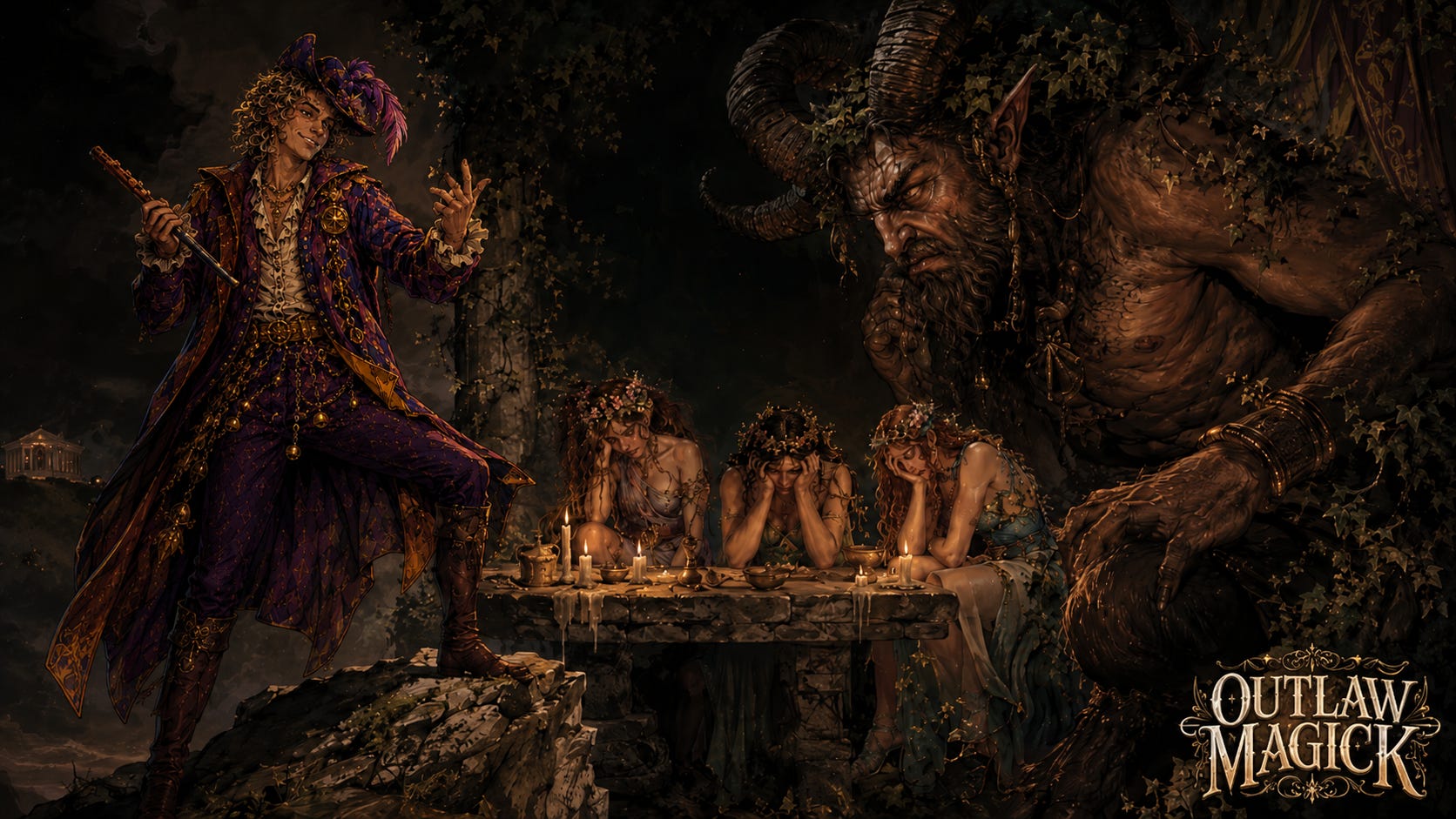
Thomas noticed the coat properly for the first time. Raspberry and cobalt and gold, panels of color that had no business agreeing with each other and did anyway, each piece a different life the coat had survived before arriving on these particular shoulders. Pied. Motley. The word for someone who had decided the not-matching was the point.
The flute was old in the way that made Thomas’s hands want to be careful. Not fragile. The opposite of fragile. Old the way stone is old, or water.
“Where did you get it,” Thomas said. Not quite a question. The honest page stirred against his ribs.
Pippin’s face did the thing faces do when they’ve been waiting to be asked.
“Sit down,” he said.
There was no sitting down available. They sat on a coil of rope that complained and then accepted the situation.
What followed was the longest short story Thomas had ever witnessed. It involved a god, a wager, three adjudicating nymphs, a technical definition of the word better, and the specific question of whether intentional incompetence constituted a violation of terms or a form of interpretation so creative it deserved its own category.
Pan had been very clear. Pippin could not play better than him. He had specified this three times. He had felt extremely secure in the wording.
He had not specified that Pippin had to try.
“I played wrong,” Pippin said, with the satisfaction of a man who still finds it funny. “Magnificently wrong. Wrong in ways that required the nymphs to convene a three-day symposium on the ontology of musical failure.”
Thomas said: “That’s not winning. That’s finding a hole in the floor and calling it a door.”
“Darling,” Pippin said, “the lock isn’t the door. The lock is just the lock.”
Thomas went quiet.
He was looking at his own throat from the inside. At the mechanism. At the thing Titania had installed that he had been treating as a prison sentence and that was, possibly, if you turned it slightly, a grammar problem.
The honest page was already out of his coat. He held it toward the flute.
The page tried. He could feel it reaching for the language, the taxonomy, the clause that would make sense of what it was looking at. It produced instead a shape. Bilateral. Almost symmetrical. The page’s honest admission that some things exceeded its jurisdiction.
He wrote around the edge in small letters: flute. won from Pan. doesn’t read. older than the page.
Pippin watched this without commenting, which Thomas was beginning to understand was its own kind of language.
The stranger intercepted them at the harbor’s edge.
Clean coat. Friendly face. A folded paper extended like something offered rather than served.
The honest page went warm against Thomas’s ribs before he finished reading the first line.
The House of Necessary Children — open enrollment. All gifted youth welcome. Severus Rex, patron.
The page was reading the seal. The mechanism underneath the charity. Every clause unpicked and laid flat. The paper said mercy. The paper meant inventory.
He knew this. His throat held it. Nobody had asked him anything.
Pippin took the paper. Read it with an expression older than surprise — something that had already happened to him in a previous chapter of himself. He folded it. Put it in his coat.
“You went very still,” Pippin said, after the stranger moved on.
“I often do,” Thomas said. True in every direction. His throat offered it freely.
Pippin looked at him for a moment with the expression of someone confirming a suspicion. He said nothing else. Which was its own kind of answer.
They parted without ceremony.
Thomas walked back toward the Nest alone.
Bartleby was already there. Not arrived — simply present, the way gargoyles are present: as though the concept of arrival did not apply, as though he had always been in this particular shadow and the shadow had simply become visible.
He placed a sheet of paper on the gangplank railing without comment. The way you return a library book.
Thomas looked at it.
A wanted poster. Motley coat. Rat imagery. A name the empire had decided to make cautionary.
The Piper of Hamelin.
The face was Pippin’s.
Thomas stood with the poster in his hands and the lock in his throat doing what locks do — nothing, because nobody had asked him anything, because all Bartleby had done was place a piece of paper on a railing and wait.
“He’s here,” Thomas said finally. Not a confirmation. A statement of fact, true in every direction, requiring nothing from his throat that his throat was not willing to give.
Bartleby made a note. Stepped back into the shadow.
Thomas looked at the poster for a long moment. At the coat drawn in cheap ink — raspberry and cobalt and gold, panels of color that had no business agreeing with each other. Pied. The word for a coat made of pieces that don’t match, worn by someone the empire had decided was the problem.
He folded it. Put it in his coat. Walked up the gangplank.
The ship received him.
Author’s Note:
The historical Pied Piper of Hamelin was almost certainly not a rat-catcher. Medieval scholars believe he was a recruiter — an agent of the Ostsiedlung, the Germanic eastward colonization drives of the 13th century. Villages gave up their children to populate conquered land. The music was what made following feel like freedom.
The empire filed this as a cautionary tale about a man in an irregular coat.
— Andy Might
Outlaw Magick publishes on Substack at outlawmagick.substack.com. If this found you, pass it on.