
The Tinker’s Apprentice
A Year of Cogs and Honest Pages (Ep. 9)

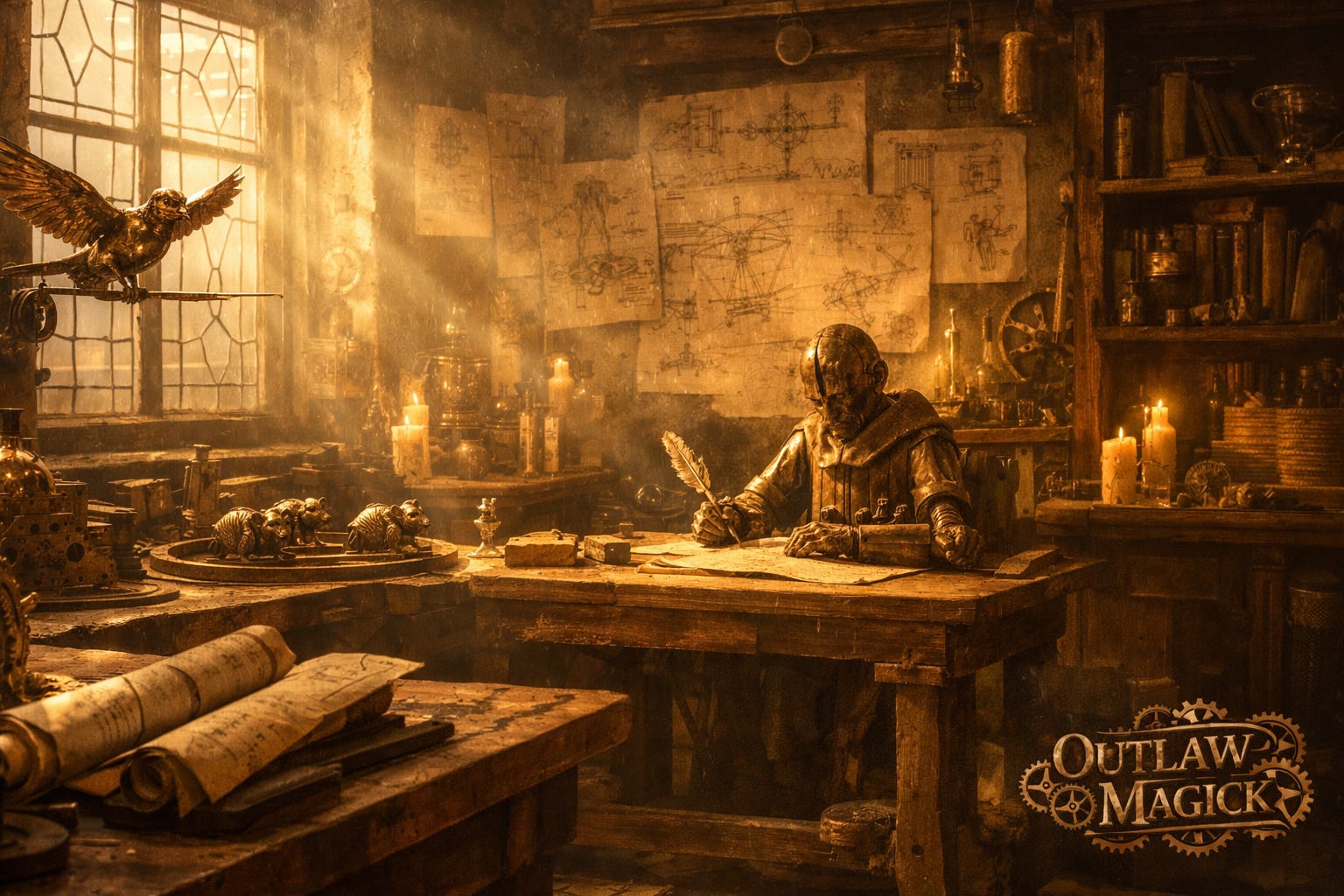
The workshop had its own climate.
Not temperature, exactly. Something closer to weather. Springs tightened and loosened the way barometric pressure changed before rain. The ticking of a dozen clocks formed a sort of mechanical wind moving gently through the room.
Thomas had lived inside that weather for a year.
He moved now with the unconscious competence of someone who had been corrected many times and survived it.
Oil the hinge before the squeak begins.
Wind the tension spring slowly or it will jump the teeth.
Never put your face directly over a coiled mechanism unless you enjoy dentistry.
He had learned that one personally.
Above him a brass swallow fluttered along a wire track near the ceiling. Its wings beat in patient arcs as it traveled from one end of the room to the other before reversing direction with polite mechanical dignity.
On a nearby shelf, a pair of clockwork mice chased one another inside a glass cylinder. Their tiny brass paws scrabbled with the tireless optimism of creatures who had not yet discovered they were running nowhere.
In the corner a monk automaton sat at a desk, writing the same Latin sentence again and again with monkish patience.
Pax vobiscum.
Pax vobiscum.
Pax vobiscum.
The gears beneath his robe turned slowly, with the contented rhythm of a prayer wheel.
And on the edge of the workbench sat a tiny brass cricket.
Its legs rubbed together.
Chirp.
Thomas had asked about it once.
Ottovino had waved a screwdriver vaguely in its direction.
“Diagnostic instrument.”
“It’s a cricket.”
“Machines appreciate metaphor.”
The little creature hopped once and settled again.
“It listens to vibration,” Ottovino added. “Footsteps. Shadows. Doors opening. Lies approaching.”
A beat.
“Mostly footsteps. But one must allow a machine ambition.”
The cricket chirped again, as if pleased by the promotion.
Thomas liked it immediately.
Over the year it had developed the habit of migrating slowly across the bench whenever Thomas was nearby, as though obeying some private theorem of attachment only it understood.
Today it had taken up position beside a brass hinge Thomas was tightening with careful concentration.
Ottovino watched from across the room.
The boy no longer stripped screws or launched springs across the workshop with alarming regularity. Progress.
He crossed to the shelves that rose behind the worktable, those leaning ranks of leather spines and notebooks swollen with damp, soot, grease, and genius pursued past good manners.
“One year,” he said.
Thomas looked up.
Ottovino did not turn. “Choose one.”
Thomas blinked. “Any of them?”
Ottovino’s ears twitched. “I did not say admire one from a distance. I said choose.”
Thomas stood.
The offer seemed at first too large to be trusted. The shelves had always been there, but as rust was there. As adulthood was there. As danger was there. He had not imagined them opening toward him.
He moved along the spines with the caution of someone entering a chapel uninvited.
There were books on clock towers, siege engines, wing hinges, devotional organs, self-turning spits, collapsible bridges, canal locks, automata disguised as saints, saints disguised as automata, toy theaters, trapdoors, forced perspective, and one scorched volume whose cover appeared to have lost an argument with lightning.
Thomas passed three impressive choices and stopped at a book that looked, by comparison, almost modest. No clasp. No ornament worth boasting of. Only a dark leather cover worn soft at the corners and one faint ring of oil near the edge, as if someone with important hands had once rested a cup on it while thinking too hard.
He drew it free.
Ottovino’s ears rose a fraction.
Not surprise exactly.
Silent praise.
Thomas set the book on the workbench and opened it.
Inside, the pages were crowded with diagrams: gears, pulleys, hinge joints, tension systems, sectional studies, architectural skeletons of machines that might or might not exist yet. Notes ran along the margins in careful backward script, written as though the author expected to read them in a mirror or was unwilling to let the uninvited arrive at understanding too quickly.
Thomas smiled before he could help it.
Ottovino noticed, of course.
“Well?”
Thomas touched one of the reversed notes with a fingertip. “It looks like it’s hiding from stupid people.”
Ottovino gave a pleased huff. “A necessary civic service.”
He came round the bench, opened the book halfway, and tapped a page that appeared, at first glance, to contain almost nothing.
Not blank.
Waiting.
“La pagina rivelatrice,” he said.
Thomas frowned at it, then at him.
Ottovino went on, unable to resist improving his own nomenclature while he spoke. “Or la finestra meccanica, if one is feeling literal. Or, for the theatrically diseased, lo spioncino del tinker.”
Thomas sounded them out under his breath, dismissing two immediately and mistrusting the third on instinct.
Then he lifted the page and held it toward the cricket.
For a moment nothing happened.
Then the parchment darkened with indigo.
Not like ink spilled. More like thought arriving.
A line extended.
A circle closed.
A measured arc found its center.
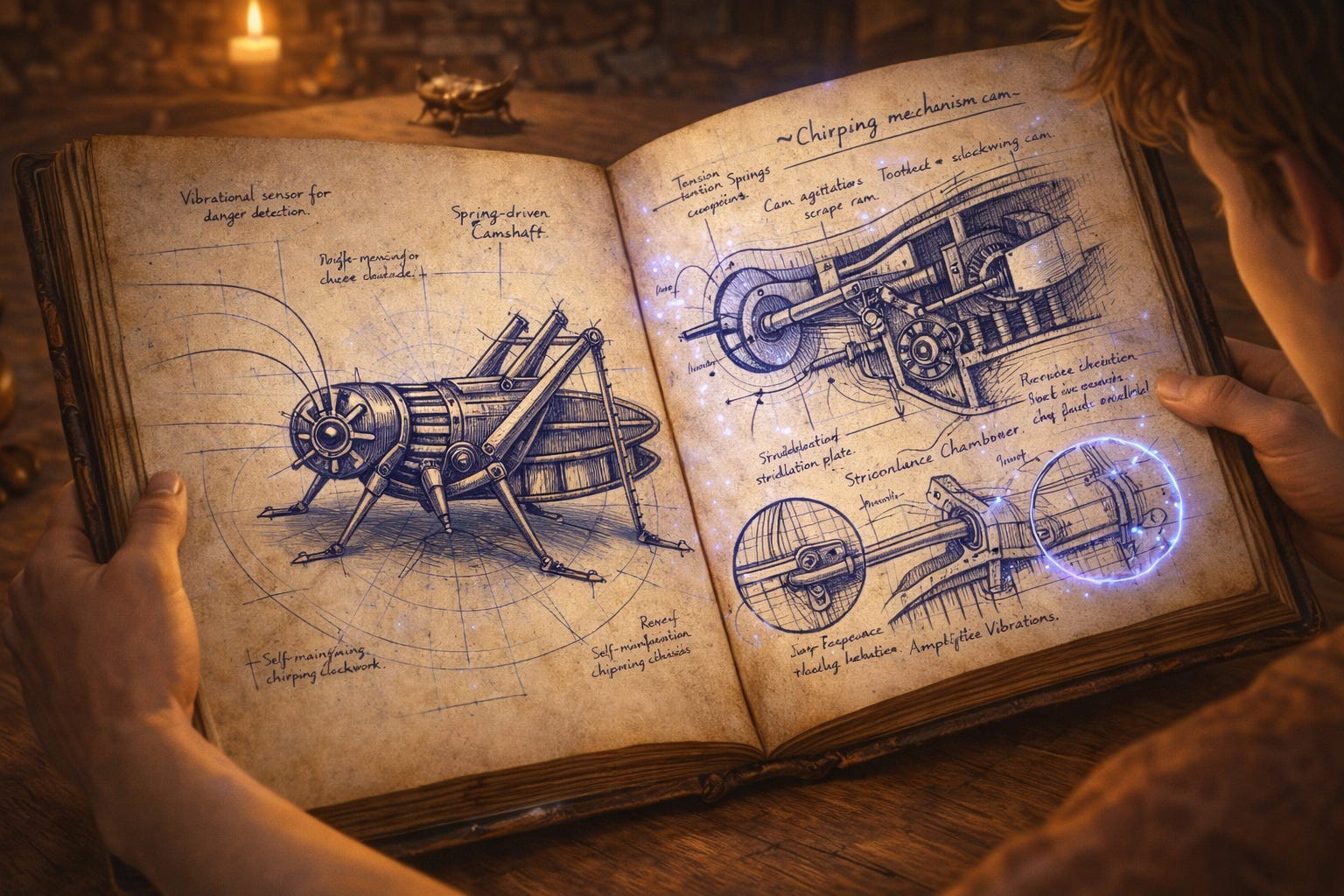
A note began at the margin in a narrow hand and stopped halfway through the word, as if the page were still deciding how much honesty Thomas had earned.
On the left-hand page, the cricket appeared in full profile, clean and exact, every leg and joint rendered with elegant severity. On the right, deeper mechanisms unfolded: a spring-driven cam, a ridged stridulation plate, a tiny resonance chamber, motion arrows, sectional cuts, one unfinished detail ring still writing itself as Thomas watched.
The brass insect on the table remained a cricket.
The one in the book had become a table of contents.
Thomas lowered the page.
The indigo thinned and vanished.
He lifted it again.
This time the drawings returned more quickly, as though the book had recognized both object and witness.
The cricket chirped.
Thomas stared.
Ottovino folded his forelegs and tried, unsuccessfully, not to look smug.
“You see.”
Thomas did not lower the book. “It’s showing what it knows.”
Ottovino tilted his head. “Closer.”
“What it was built to know.”
“Better.”
Another note wrote itself in indigo along the right margin. The unfinished circle tightened. A small motion line quivered into place beside the chirping arm.
Thomas smiled. “The honest page.”
Ottovino made a face that suggested this was exactly the sort of peasant brilliance he found professionally inconvenient.
“It is not honest,” he said. “It is revelatory.”
“It tells the truth.”
“It tells the design.”
“That’s the same thing for a machine.”
Ottovino’s brass paw clicked once against the wood.
“Only an apprentice would say so with such confidence.”
Thomas lowered the page and looked at him. “Then it’s an apprentice name.”
There was the silence of disagreement.
Then the rarer silence in which Ottovino was revising his opinion and resenting the labor involved.
Finally he said, “Pagina onesta is barbarously good.”
Thomas grinned.
Ottovino sighed through his nose. “Which is why, against all standards, it may survive.”
He nudged the page back toward the cricket.
“Again.”
Thomas lifted it.
This time he saw beyond the charm.
Here was not merely a chirp, but a sequence.
Force gathered.
Force translated.
Force released.
A warning made small enough to be loved.
The book was not showing him the cricket’s insides as a butcher might see them. It was showing him its logic. Why this spring. Why that chamber. Why one delicate rasping leg could carry alarm farther than something twice its size and ten times as vain.
On the right page, the last unfinished ring closed at last.
The cricket chirped, smugly.
Thomas laughed.
Ottovino allowed himself the smallest possible look of satisfaction.
“Leonardo dissected corpses, you know,” he said. “Birds, men, rivers, storms. Everything except bureaucracy, which is a pity, as it might have saved us all some time.”
He tapped the page.
“Always the same question.”
How does it move?
Thomas kept looking through the spread. For the first time he did not see something small. He saw a principle.
A kindness disguised as nuisance.
A warning disguised as toy.
Care engineered into form.
He lowered the book slowly. “You made this for danger.”
Ottovino wiped grease from his fingers with a rag.
“I made it because workshops are full of optimism, and optimism is how people lose fingers.”
The cricket chirped.
“Also,” Ottovino added, “I dislike being surprised by boots.”
Thomas glanced down at the little instrument with fresh respect.
“It listens to danger.”
“It listens to change,” Ottovino corrected. “Danger is merely the least courteous form of it.”
He took the book back, turned several pages, then handed it over once more.
Thomas looked down and saw arches, locks, tension maps, rotational chambers, collapsible stairways, hinge geometries, load-bearing deceptions, narrow passages whose measurements made his skin prickle for reasons he could not yet have named. Not toys. Not companions. Not warnings. Structures.
The indigo came more slowly now, but when it did, it drew with a harder hand.
This was not charm-work.
This was appetite organized into masonry.
Thomas watched a corridor appear in section, then another crossing it at an impossible angle. A chamber whose walls seemed built to rotate. A locking sequence so elegant it felt rude. A stair that was not a stair but a trap made polite.
Something in him went cold with fascination.
Ottovino watched him notice.
“This,” he said quietly, “is why you chose it.”
Thomas looked up.
Ottovino shrugged, as if the boy’s instinct were a minor inconvenience to everyone involved. “Not because you understand it yet. Because some part of you already means to.”
Thomas looked again at the page. At the cricket. At the narrow, impossible kindness of a book that did not simply explain made things, but betrayed them.
The thought arrived whole.
This was not only a page.
Not only a notebook.
Not only a clever mirror-trick in indigo.
It was a way of looking.
He said softly, testing the sound of it, “A tinker’s spyglass.”
Ottovino’s ears twitched.
That earned a proper pause.
“Hm,” he said.
Thomas waited.
Ottovino weighed the book once in his paw, then returned it to him.
“Yes,” he said at last. “That is less embarrassing than the alternatives.”
Which, from Ottovino, was practically a blessing.
The cricket hopped once toward the edge of the page.
Chirp.
Thomas turned the spread back toward it and watched the indigo begin again.
Ottovino spoke half to Thomas and half to the room.
“Lately I receive requests for different machines.”
Thomas’s gaze lifted.
“Helmets that see in darkness.”
He turned the page. Lenses appeared hidden behind a visor.
“Locks that cannot be opened.”
Tumblers arranged themselves like tiny bones inside a steel cylinder.
“Cages that cannot be escaped.”
A folding prison frame revealed brutal hinge geometry.
Ottovino wiped his hands.
“These come from New Rome.”
He tested the next name carefully, as though even here it might sour the air.
“As do the requests.”
“Severus Rex.”
The workshop continued ticking.
The cricket stopped chirping.
Just for a moment.
Then:
Chirp.
Ottovino shut the book.
“I do not build those machines.”
He crossed to a crate near the wall and nudged it toward Thomas.
“I do, however, have a delivery for you to make.”
Thomas brightened. “A delivery?”
“To a colleague.”
“Another inventor?”
Ottovino considered. “In a way.”
He opened the crate.
Inside lay a marionette.
Carved wood. Jointed limbs. Yet the joints were threaded with delicate brass hinges. Tiny springs nested inside the shoulders. A narrow mechanism ran through the spine.
Thomas, almost without thinking now, lifted the book and held it toward the puppet.
The indigo obeyed.
Across the page, its hidden architecture bloomed into being: balance points, spring tension, spinal transfer, the strange and beautiful treachery of motion waiting to occur. A puppet designed to move… even without strings.
He had already looked. He could not help it.
Not a marionette, then. Not really. No visible master. Only wood, brass, intention, and the means to move as if freedom had been engineered into it from the start.
Thomas stared a beat too long.
Then, with the small cold jolt of recognition, he thought: It looks like me.
Ottovino shut the lid.
“A theatrical experiment.”
“For a puppeteer?”
Ottovino nodded.
“Maestra Tagliafili.”
Thomas tried the name.
“String… cutter?”
Ottovino pushed the crate across the table.
“Try not to become part of the show.”
Thomas left the workshop that evening carrying the crate under one arm and the book tucked carefully into his coat.
Behind him the automata resumed their quiet industry.
The swallow turned on its wire.
The monk continued writing.
The mice chased one another forever.
On the workbench the tiny brass cricket paused.
Then it hopped once.
And once again.
And slipped neatly into the edge of the crate before the lid settled closed.
Chirp.
Author’s note:
This passage condenses a whole Bildungsroman into one apprenticeship scene: a boy learns not simply how machines work, but how to read design, intention, and the hidden logic inside made things. I drew on Leonardo da Vinci’s notebooks, mirrored script, anatomical studies, and mechanical obsessions, while letting Ottovino’s little brass cricket nod toward Pinocchio’s conscience-keeper and transform into something more practical for this world: a danger-sense, a mechanical familiar, a warning made small enough to love.
The Tinker’s Spyglass is the first appearance of a tool that will matter enormously later, when Marlowe must read the Labyrinth not as a prison but as a machine with beliefs built into it. In that sense, this is the beginning of the heist long before anyone knows a heist is coming.