
A Kinder Rope
The Terrible Possibility Of Being Strange In Public And Surviving (Ep. 14)

STORY SO FAR: Thomas Marlow — fourteen, Scottish, allergic to lies his throat won’t let him tell — has been hanged from a cypress tree by two con artists on a road outside Florence, rescued by Titania the Blue Fairy who claimed him with the words “I do not keep unfinished things,” and delivered back to the world with the rope’s lesson still in his neck and turquoise smoke leaking from his eyes when feeling gets too large to hold. Read from the beginning.
He has been here before — to Bríd’s Nest, the floating cabaret sanctuary moored crookedly in the harbor, run by Bonnie Bríd, a leprechaun impresaria descended from the sun god Lugh, who collects everyone the empire has diminished and puts them on a stage.
He comes back now without a crate, without an errand, without a cover story his throat will permit him to tell.
He came back the way bad news comes — at the wrong hour, without announcement, wearing the evidence before he could think to hide it.
The gangplank recognized him. Or seemed to. It dipped under his weight with the specific complaint of something that remembered the last time and had opinions about the interval.
He had no crate.
No instructions repeating themselves in his head with the precision of wound springs.
No cover story his throat would permit him to tell.
He had the rope’s lesson and the iron taste that wouldn’t fully leave and the faintest line of glitter on his cheek he had not washed off because washing it off had felt, in some way he couldn’t name, like a second loss.
The ship received him anyway.
Inside, the corridors were quieter than the first time. Pre-show quiet — that specific theatrical hush that is not emptiness but held breath, the whole ship knowing something was about to happen and organizing itself accordingly. Colored lanterns swayed. Somewhere below, a drum tested itself and stopped. The smell of greasepaint arrived and then the smell of something frying in good oil, and beneath both, the cardamom-smoke-coin scent that Thomas had not known he’d memorized until it reached him now like a hand placed on the shoulder from behind.
No one stopped him.
The antlered boy was tuning again under his lantern, or still tuning, or always tuning — Thomas couldn’t tell if time moved differently on the ship or if the boy simply had a relationship with readiness that required constant renewal. He glanced up. Took in the coat, the face, the absence of a crate, the presence of something else.
He looked back at his strings without comment.
Which was its own kind of kindness.
Bríd was in the backstage room.
She was seated at the chart table with a needle and a length of wool the color of heather in poor light — not purple exactly, not grey, something between the two that had no name in Italian and probably didn’t need one. She was mending with the focused competence of someone for whom mending was not domestic but theological — each stitch placed with the precision of someone who understood that what you repair, you are also claiming.
She looked up when Thomas entered.
She did not gasp.
She did not make a sound at all for a moment.
She simply looked at his neck the way a craftsperson looks at damage — fully, without flinching, measuring what had happened against what could be done about it.
Then she set down her needle.
“Sit,” she said.
Not a question. Not unkind. The word a healer uses when they need the body cooperative and stationary.
Thomas sat.
Bríd came around the table with the particular efficiency of someone who had done this before — not this exactly, not a boy with a rope’s lesson on his neck, but tending. The specific practice of looking at what had happened and not looking away from it and deciding what it needed.
She took his chin in two fingers.
The gesture was not gentle.
It was exact.
Thomas thought, distantly, of another hand that had done the same thing. He pushed the thought away.
Bríd turned his head slightly. Examined. Her eyes were doing the priest-watching-weather thing — not for beauty, not for horror, for information.
“Who,” she said.
“Two people on a road,” Thomas said. “They’re not — they won’t—”
“No,” Bríd agreed. “They won’t.”
She said it with the calm certainty of someone who knew the end of that sentence not because she’d been told but because she was old enough to know which stories had which endings.
She went to a chest in the corner. Thomas had not noticed it before. It was small and battered and had the look of something that had crossed water more than once, that had been carried when everything else was left behind. The lock on it was old iron worked into the shape of a sun with too many points.
She opened it without ceremony.
Inside, folded with the care given to things that have earned their keeping, was a length of wool.
Heather-between-grey. The same color as the piece on the table, except older. Worn to a softness that fabric only achieved through decades of contact with a body that loved it.
She lifted it out.
Thomas watched her hands.
“Is that—”
“From home,” Bríd said. Simply. Completely.
She came back to him and wound the scarf around his neck with the brisk tenderness of someone who knew the difference between covering a wound and hiding one. Snug enough to be warm. Loose enough to breathe. The wool smelled of something Thomas had no word for — cold air and old fires and the specific mineral quality of Highland rain, a smell that had no business being in an Italian harbor and was here anyway, preserved against all reasonable expectation.
His throat, which had been conducting a cold and ongoing argument with the memory of the rope, went briefly quiet.
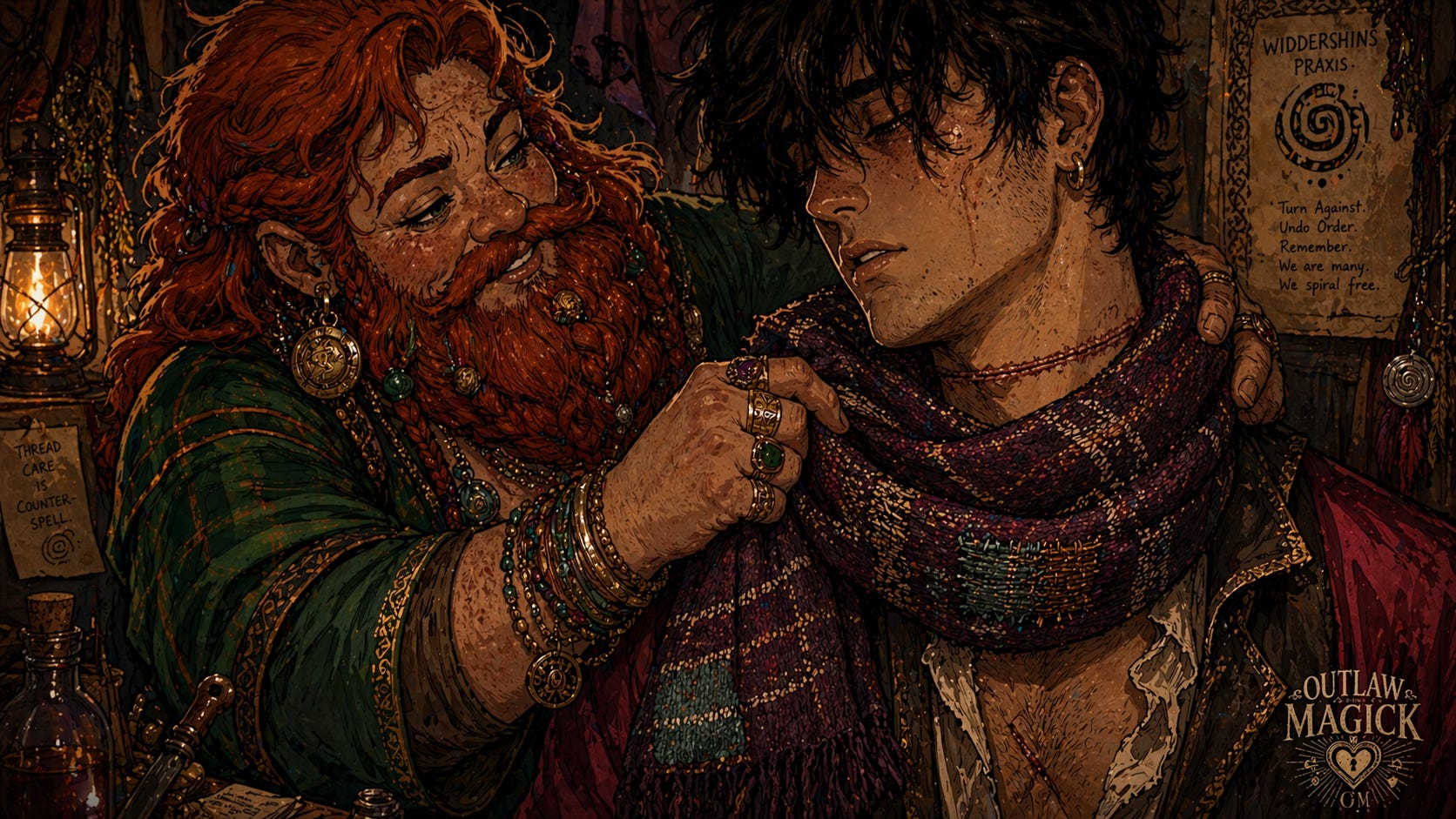
Not healed. Held.
Bríd smoothed the wool once with her palm and stepped back.
“My people were gods once,” she said, conversationally, as if continuing a thought she’d been having for some time. “Sun god. Patron of crafts. Warrior king. Then the empire arrived and classified us.” She picked up her needle again. “Small body. Trick. Joke. Caricature. Green hat.”
She pulled a stitch through.
“I decided if they were going to make me small, I would build something large enough to hold everyone else they diminished.”
Another stitch.
“The ship is the argument.”
Thomas touched the scarf.
The gesture was involuntary. His fingers found the wool and stayed there, not pulling, not adjusting. Just — present. The way you touch something to confirm it’s real.
Bríd watched this in the mirror without seeming to.
“You came back,” she said.
“Yes.”
“Without an errand.”
“Yes.”
The locked door in his throat held its position faithfully. No false explanation rose to fill the space. The room received the silence without complaint.
“Good,” said Bríd.
Author’s Note
This episode is indebted to the earliest leprechaun lore — not the greeting-card version, but the Tuatha Dé Danann tradition: gods the empire diminished into footnotes, the sun god Lugh made small, female leprechauns in medieval manuscripts who were mobile, powerful, and impossible to keep in one place. Bríd carries all of that in her beard and her bells and the chest that crossed water.
It is also, more personally, indebted to a drag performer named Hurricane Summers, who took me in at sixteen and did exactly what Bríd does here — not rescue, not a speech, just a woman who had built something large enough to hold everyone the world had diminished, making room without making it mean more than it was.
This one’s for Hurricane.