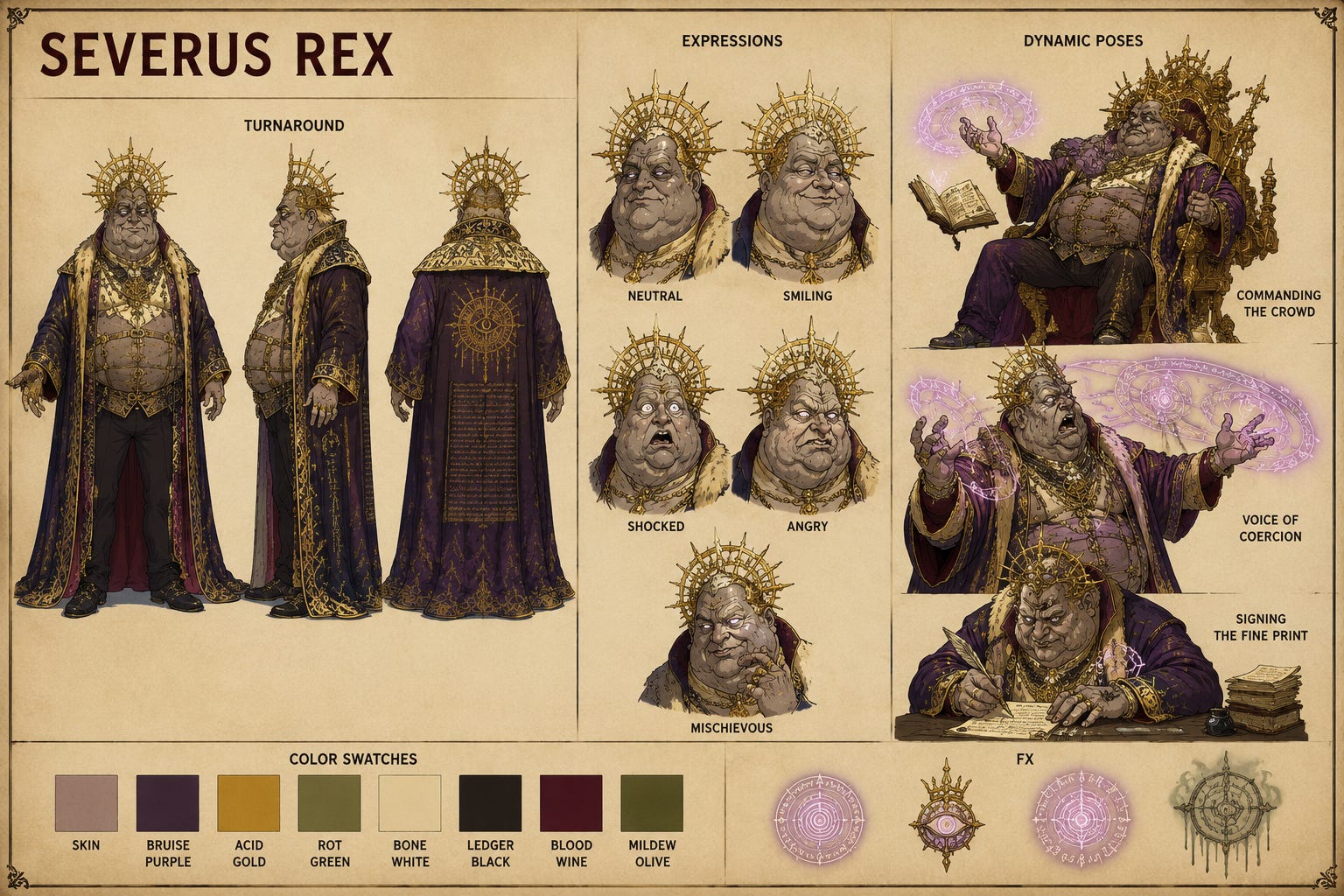
The Golden Rex
Five Hands Blessed the Crowd While the Sixth Picked Their Pockets (Ep. 20)

By morning, Siena had been polished against its will.
Banners hung from every balcony. District animals snarled, strutted, flew, crawled, and coiled in embroidered armies above the streets. Wolves over butchers. Snails over bankers. Dragons over boys selling onions. A goose large enough to frighten theology itself flapped from the tower of a guildhall.
Everywhere, bells.
Everywhere, drums.
Everywhere, children.
They carried garlands. They carried candles. They carried little golden masks of Severus Rex’s smiling face.
Thomas hated the masks most.
“They’re too young to look that grateful,” Mina said beside him.
Across the Piazza del Campo, workers pulled a vast cloth of mirrored gold over something enormous. Only the feet showed beneath it.
Massive.
Polished.
Bare toes planted on Siena stone as if the city had been born to hold them.
“What is it?” Thomas asked.
Pippin appeared behind him carrying sugared almonds in a paper cone.
“A very expensive insecurity.”
Bríd, standing at the bow of the Nest where it had been moored as part of the “approved entertainments,” squinted toward the square.
“The Golden Rex,” she said. “Unveiling at noon. Mandatory joy begins at eleven.”
—
The procession started with animals.
Not real ones.
Worse.
Symbols.
Each district marched behind its beast: painted wolves, silk owls, papier-mâché dragons, wooden porcupines on wheels, a magnificent snail carried by sixteen exhausted boys and one furious nun.
Crowds cheered their own banners and booed everyone else’s with civic devotion.
Then came the Custodians.
White horses. Silver bridles. Armor polished hard enough to accuse the sun.
Behind them marched children from the House of Necessary Children in cream uniforms, each carrying a candle in one hand and a ledger in the other.
The girl known only as Nineteen vanished her marked wrist inside her sleeve.
Thomas noticed.
So did Bartleby, high above on a scaffold, writing.
The music changed.
Pippin went still.
“What?” Thomas asked.
“They’ve tuned the square.”
“That’s not an answer.”
“It is if you’re frightened properly.”
The drums landed at walking pace. The bells answered every fourth beat. A children’s choir entered just above speech, forcing the crowd to lean closer without knowing why.
Pippin’s face had lost all comedy.
“No no no,” he murmured. “That is not festival rhythm. That is conquest wearing rouge.”
—
The pageant began before Rex appeared.
A troupe of masked “idle boys” danced across the central stage in ribbons and donkey ears, mocking priests, kicking over school benches, and throwing fake coins into the crowd.
The audience laughed.
Then the boys became hungry.
Then violent.
Then stupid.
Their ears grew longer. Their hands curled into hooves. Their laughter turned to braying.
The musicians playing them were excellent.
That made it worse.
A golden narrator announced that without order, children became beasts. Without labor, pleasure became rot. Without Rome, every city became an island of fools.
Thomas felt the words looking for a place to live inside him.
They did not fit.
But he saw other people making room.
Mothers nodded.
Merchants applauded.
Hungry men looked ashamed of their own hunger.
Then the children of the House entered, clean and smiling, carrying bread.
The crowd wept.
Bríd muttered, “The bastards hired competent designers.”
—
At noon, trumpets sounded from the northern gate.
The real Severus Rex arrived beneath a canopy of mirrored cloth.
He was smaller than the statue.
That was Thomas’s first thought.
Smaller, softer, older than the golden thing waiting beneath its veil.
But when Rex lifted one hand, the square quieted so completely that even the pigeons seemed to reconsider themselves.
He did not shout.
He did not need to.
“My beloved Siena,” he said, voice warm as fresh bread and just as useful for hiding knives. “You have many stories about yourselves. Too many, perhaps. Every district wounded. Every banner righteous. Every bell certain it alone knows heaven.”
A soft laugh passed through the crowd.
Rex smiled with paternal sadness.
“Freedom is a beautiful word. So beautiful that people rarely examine it closely. And children, especially, deserve more than beautiful words. They deserve bread. Shelter. Predictability. Safety. The world is already cruel enough without asking the young to invent themselves from nothing.”
Thomas felt the crowd lean toward him.
Not everyone.
Enough.
Rex turned slightly, letting the golden cloth behind him catch the sun.
“I have not come to conquer Siena. Conquest is crude. Expensive. Very poor for trade. I have come to help this city remember itself.”
He paused.
“A city should not be a quarrel with walls. A city should move with the elegance of a single thought.”
The brass cricket began to vibrate inside Thomas’s coat.
Not chirping.
Shaking.
Rex turned toward the veiled monument.
“Let this image stand not as vanity, but as promise.”
The ropes fell.
Gold exploded into daylight.
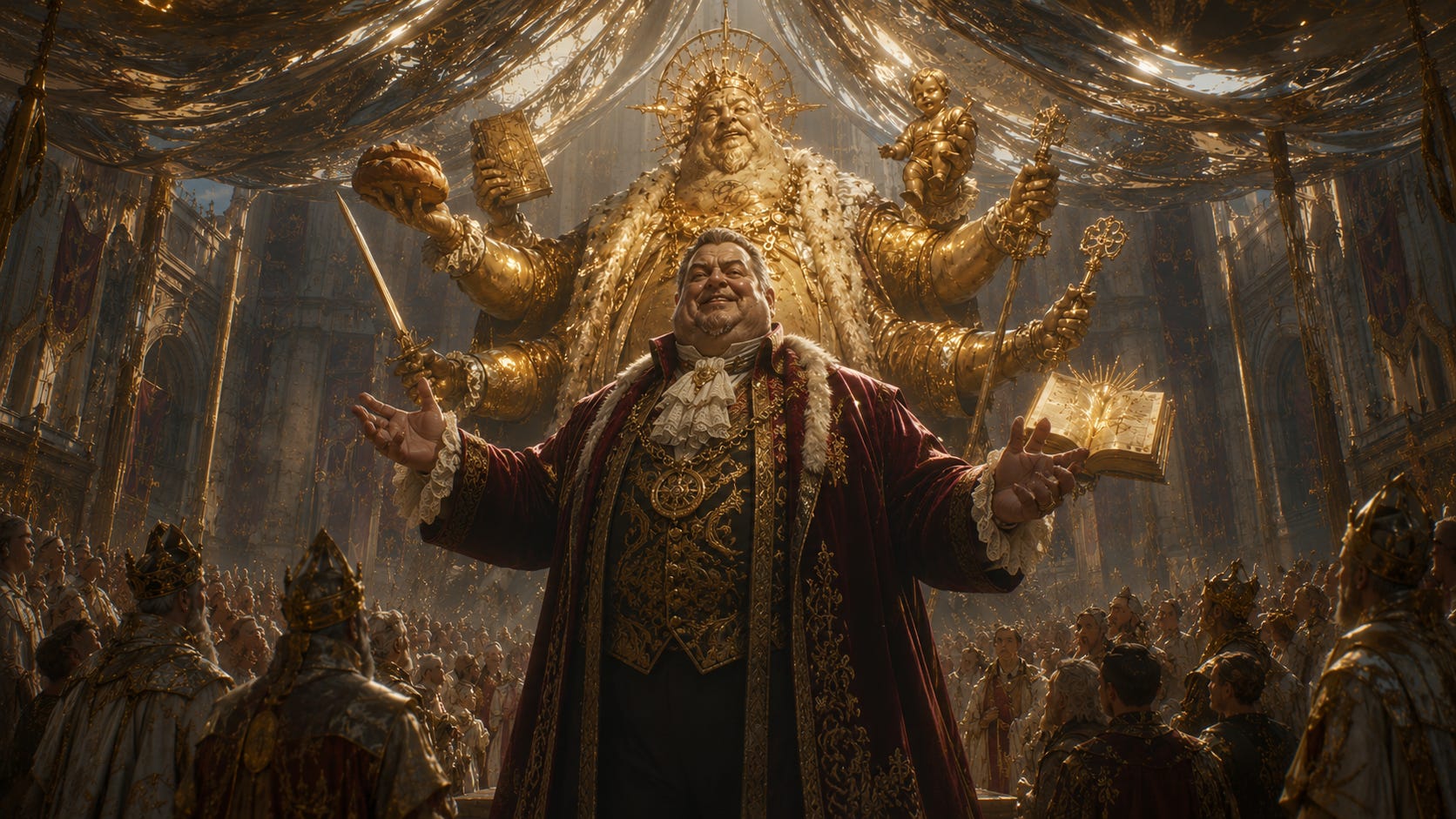
The statue towered above Siena: Severus Rex remade as saint, emperor, father, and judge. Young, beautiful, impossible. Six arms extended outward: one holding bread, one law, one sword, one child, one sceptre, one key.
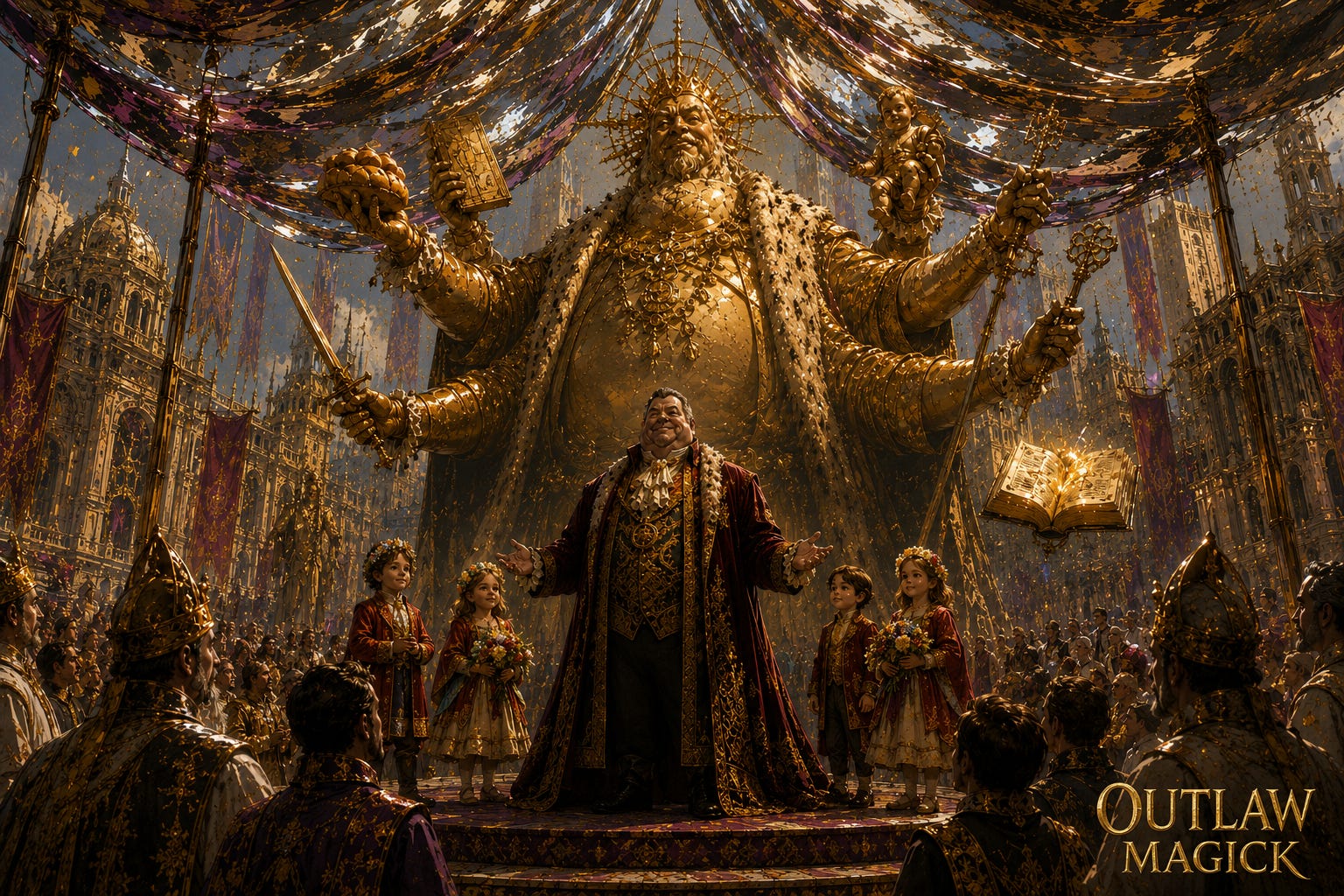
The face did not resemble Rex.
Not truly.
It resembled what fear wanted Rex to be.
A cure.
The crowd broke open.
Cheers.
Boos.
Sobs.
Prayers.
Laughter.
A tomato struck the statue’s golden shin and slid down like blood.
Then pamphlets began falling from the rooftops.
Hundreds of them.
Thousands.
Anti-Rex woodcuts spinning through incense smoke.
HE COUNTS CHILDREN LIKE COINS
THE HOUSE HAS NO WINDOWS
MERCY IS ONLY LABOR WITH A HALO
The square erupted.
Custodians surged toward the buildings. District boys blocked them with banners. Someone set fire to the giant snail. The nun riding inside it began shouting tactical instructions.
A horse reared.
A scaffold cracked.
One of the House children fell beneath the movement of the crowd.
Pippin lifted his flute.
Thomas grabbed his wrist.
“No.”
Pippin looked at him.
A scream tore through the square.
Thomas let go.
Pippin played.
Not loudly.
Not beautifully.
Necessary.
The melody threaded through panic and found the body underneath it. People stopped pushing forward and began moving sideways. Gaps opened. Children passed through them first. Then elders. Then the fallen.
The burning snail rolled harmlessly into a fountain.
For one impossible minute, Siena moved as if it remembered how to be one thing without becoming obedient.
Then Pippin stopped.
The crowd became itself again.
Messy. Furious. Alive.
High above, Bartleby wrote so fast his quill split.
Below, Severus Rex turned slowly.
His eyes found the Nest.
Then Pippin.
Then Thomas.
Only for a breath.
But Thomas felt the look enter him like a name being written in wet ink.
—
That night the House came quietly.
Not with soldiers.
Clerks.
Seven of them in gray gloves, carrying ledgers beneath oilcloth covers.
The leader smiled pleasantly at Bríd.
“Routine census correction.”
Bríd stood at the gangplank with one hand on her hip.
“At midnight?”
“Order rarely sleeps, madam.”
“Poor thing. Has it tried wine?”
The clerk smiled harder.
“We have identified undocumented minors associated with your company.”
“We’re actors,” said Bríd. “Half of us are undocumented adults.”
His gaze shifted past her.
Toward Thomas.
He opened the ledger.
Thomas saw himself already there.
SCOTTISH MALE. APPROXIMATE AGE: FOURTEEN. FAIRY CONTAMINATION CLAIMED. VERACITY ANOMALY REPORTED.
Below that:
TRANSFER RECOMMENDED.
The cricket screamed inside his coat.
The clerk’s smile softened.
“Ah,” he said.
“There you are.”
Author’s Note: This chapter draws inspiration from Siena’s transition from republic to Medici rule after 1555. Literary influences include Carlo Collodi’s Pinocchio, Terry Pratchett’s Small Gods, and Ursula K. Le Guin’s moral fables. History provided the pageant; fantasy supplied the masks.