The Crucible
The Purpose of a Gift Is Its Use (Ep. 22)

The bells rang before sunrise.
Not church bells. Not alarm bells.
House bells.
Thomas had already learned there was a difference.
Church bells invited devotion. Alarm bells demanded obedience. House bells assumed both.
Children emerged almost immediately, filing from dormitories in orderly streams, each wearing the same expression Thomas had begun seeing everywhere inside the House.
Expectation.
Not dread.
Hope.
That disturbed him.
Pippin appeared beside him carrying an apple and the expression of a man who had decided optimism was somebody else’s problem.
“They’re preparing.”
“For what?”
Children crossed the courtyard wearing metal tokens on cords at their collars. A wing. A key. A sheaf of wheat. A compass. A candle. A pair of scales. Some wore one. Others wore several.
“They’ve already been sorted?” Thomas asked.
“No,” said Milla. It was the first thing she’d volunteered all morning. “They’re older. You receive them afterward.”
“They’re called placements,” said a passing girl. She wore three tokens herself. “They’re honors.”
Pippin watched her disappear. “They’ve turned identity into metalwork.”
At breakfast a boy sat surrounded by pigeons. Ten of them. All staring at him like advisors around a king.
One cooed.
The boy sighed. “No.”
Another. “No.”
Another. “The north roof.”
A pause. “No, I know where the north roof is.”
Thomas stopped.
The boy looked up. “They’re arguing.”
“The pigeons?”
“They always do.”
His name was Matteo. Ink-stained fingers. A coat one season too large. He understood birds the way Thomas understood when people were lying — not as a skill, as a condition.
“When do you go in?” Thomas asked.
“This morning.”
“Worried?”
Matteo’s eyes drifted toward the tower. “I’d like to know why they talk to me.”
“And the House will tell you?”
He looked genuinely surprised by the question. “So I can finally be useful.”
The words landed harder than Thomas expected. Not because Matteo sounded manipulated. Because he sounded relieved.
The House had offered him something no one else ever had.
An explanation.
Outside the Hall of Appraisal, long tables stretched beneath the cloister arches.
Possessions were surrendered. Not confiscated. Catalogued. Everything described, measured, recorded, assigned a number. The House collected biographies through belongings.
A girl surrendered a cracked saint’s medal. A boy produced a compass that spun whenever someone nearby lied. Another reluctantly handed over three polished stones that hummed when separated.
Every object received a brass tag.
Nothing here was merely owned.
Pippin produced his pipe. The moment it touched the table it rolled away from the clerk, then back, then whistled.
ACTIVE INSTRUMENT.
“I object.” Pippin said. “It isn’t active. It’s expressive.”
Nothing changed in the ledger.
Milla approached. “I don’t have anything.”
Roux sneezed. Three warm rolls appeared on the table. One was buttered.
Nobody moved.
The assessor wrote: PROBABILITY-LINKED MANIFESTATION.
“He’s a dog,” Milla said.
“I’m recording both.”
Thomas laid the brass cricket on the table. It vibrated so hard the inkpot rattled. Beside it he placed the Honest Page.
Three assessors noticed simultaneously.
“What is this?”
“It shows me how things work,” Thomas said. “The machinery underneath.”
Thomas raised it instinctively. The mirrors didn’t change. No magic appeared. Instead the Page filled with lines. Counterweights. Mirror tracks. Hidden gears. Mercury channels beneath the floor. Observation galleries behind stone walls. Pressure valves. Balance arms.
Someone had built every hinge. Every mirror. Every gear.
One assessor wrote: MECHANICAL REVELATION DEVICE. Another crossed it out. Wrote: STRUCTURAL ANALYSIS.
Bartleby watched from across the room. His quill moved. Thomas noticed he wasn’t recording the Page. He was recording the people recording the Page.
That felt more important.
The children waiting outside the Hall spoke in whispers.
“She’s never in the room.”
“She’s in the mirrors.”
“All of them?”
“Every polished surface. My sister said she saw her in a spoon.”
“That’s not possible.”
“My sister doesn’t lie.”
“What does she do?”
A pause.
“She looks at you. And then she knows.”
“Knows what?”
Nobody answered.
The doors to the Hall opened.
Inside, what had once been a chapel had been improved. Saints lingered beneath fresh plaster. Brass pipes climbed marble columns. Polished lenses hung from chains. Silver discs rotated overhead.
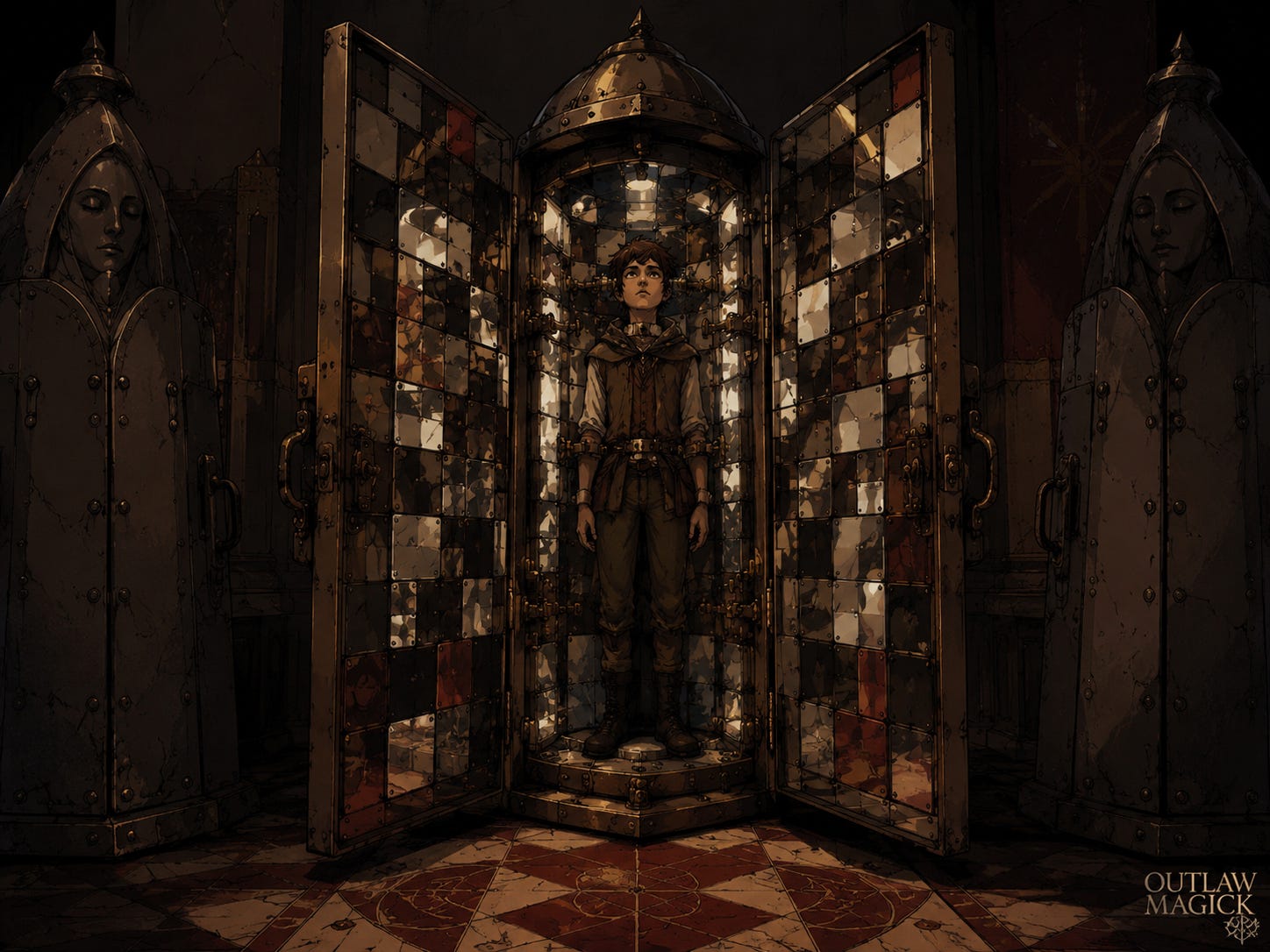
At the center stood the Crucible.
Thomas stopped walking.
He had imagined something dreadful. Something spiked. Something theatrical.
Instead it was beautiful.
Nearly twenty feet tall, it rose like a reliquary designed by an engineer. Brass. Iron. Mercury glass. Crystal. Obsidian. Silver. Hundreds of mirrors nested inside one another like petals folded around an unseen flower. A narrow chamber where a single child could stand while every possible angle of their body disappeared into reflection.
Above it, carved into white stone:
THE PURPOSE OF A GIFT IS ITS USE.
No one read the inscription. Everyone already knew it.
Thomas wondered which was worse.
Then something changed in the room.
Not dramatically. Quietly.
The silver bowl on the assessor’s table clarified. A polished brass instrument caught an impossible reflection. A window. A goblet. A polished buckle. Reflection after reflection slowly aligned.
One eye in polished silver. A hand in still water. A profile in black obsidian. Hair dark as raven feathers except for a single white streak.
She did not move between mirrors. The reflections moved around her. She was already there. Watching. A one-eyed raven on her shoulder, watching too.
The room fell silent.
Her voice emerged from every reflective surface at once.
“This way.”
She did not command. Children simply obeyed. Thomas realized with unease that he had already taken a step toward the Crucible before deciding to.
Matteo was called first.
The pigeons outside erupted into wings.
“They’re arguing whether I’m coming back,” Matteo said. Then he walked through the doors.
They closed behind him.
The children outside heard nothing. The Crucible gave nothing away. Only the occasional shift of Ravenna’s reflection moving through available surfaces — a water glass, a lens, the lacquered surface of a clerk’s writing box — suggested anything was happening at all.
After perhaps ten minutes her voice emerged from the bowl of water on the assessor’s table.
“Aviary Liaison.”
The doors opened. Matteo stepped out blinking. Older children wearing wing tokens welcomed him immediately. One clasped his shoulder. Another hung a blue cord at his collar with a small cast wing threaded onto it.
The relief on Matteo’s face was so complete Thomas almost envied him.
For one dangerous moment the House looked right.
Pippin entered with a bow.
Five minutes later every reflective surface in the room briefly fogged. Something that sounded like a fiddle emerged from the mercury channels beneath the floor. Two clerks began tapping their feet before noticing and stopping.
Ravenna’s voice from a nearby lens: “Public Harmony.”
Pippin emerged. Looked at the token. Looked toward the nearest mirror. “That’s not what I do.”
Her reflection in the water glass tilted very slightly. “No. It is what happens.”
For the first time since Thomas had met him, Pippin had nothing to say.
Milla entered. Roux stayed behind, sitting perfectly still with an expression of profound personal grievance.
Inside, something went wrong immediately. Thomas could tell from the mirrors. Ravenna’s reflection multiplied, moved quickly between surfaces, paused, moved again. The water glass rippled without being touched. A lens clouded. A polished disc spun too fast and stopped.
Twelve minutes passed.
Then: “Value Translation.”
Milla emerged without looking at the token. She knelt and wrapped both arms around Roux. The bread dog licked her cheek.
One assessor leaned toward another. Thomas caught only: “...inform the Alchemist King.”
Bartleby’s quill scratched once. Thomas noticed he hadn’t written beneath Milla’s name. Only beneath Roux’s.
“Thomas Marlowe.”
The cricket vibrated so violently it hurt.
The Crucible opened. Hundreds of mirrors waited. Somewhere in every reflective surface Ravenna was already watching.
“This way.”
Thomas stepped inside. The doors embraced rather than locked. Padded supports settled against his shoulders and spine. A curved plate adjusted behind his head. The machine preferred stillness.
The mirrors did not.
They searched him the way the archive had — not for what he was, but for what happened after him. One focused on the cricket. One lingered on the bruise beneath his collar. One seemed fascinated by the Honest Page. None reflected all of him at once.
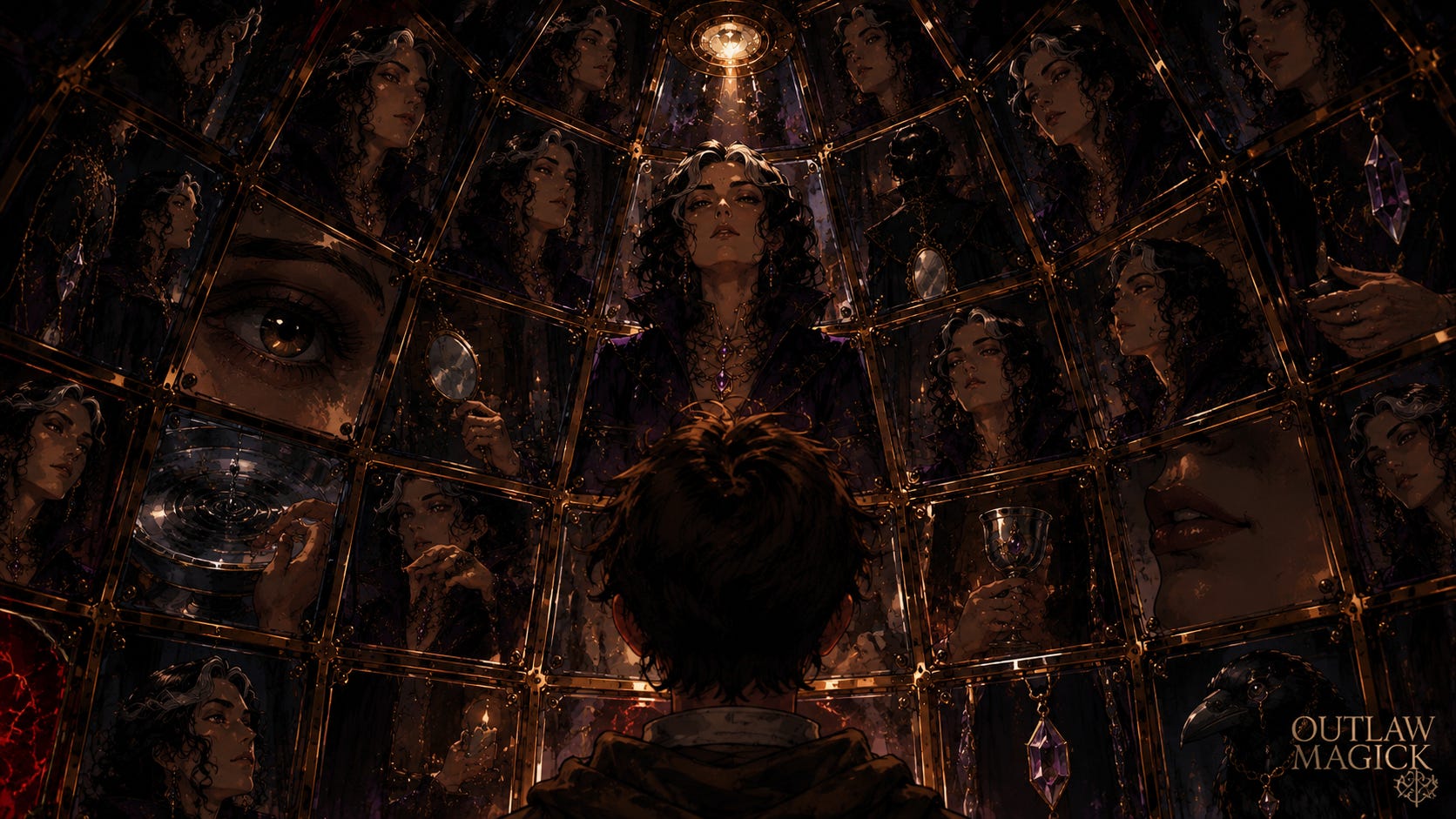
Ravenna assembled herself from available surfaces. An eye in silver. A mouth in obsidian. Finally both eyes.
“Thomas.”
She said his name like reading it from a page.
“You aren’t quite what I expected.”
“You were expecting me?”
“Not you. The question.”
She moved through reflections. Reading rather than asking.
“You distrust machinery.”
He wanted to deny it. “Yes.”
“You trust children.”
“Yes.”
“You cannot lie.”
“No.”
That made her pause. “Cannot?”
The answer left him before he chose it. “Physically cannot.”
She watched him demonstrate. His throat tightened. His tongue refused. No sound emerged.
“I see.” She did not ask again. She believed demonstration more than testimony.
The mirrors continued their inventory.
Violence witnessed. Responsibility carried beyond his years. Companions unusual enough to worry about naming. The Nest. Bríd. Every truth another thread laid into the empire’s hands. Ravenna never celebrated. She simply continued.
Finally: “What protects you?”
“What?”
“There.”
A mirror behind him brightened blue. Softly. Like moonlight beneath water.
Ravenna leaned closer to her reflection. For the first time she looked uncertain.
“What touched you?”
The word arrived before he chose it.
“Titania.”
Every mirror stopped. Mechanically. The gears ceased. The mercury settled.
Ravenna did not gasp. She moved from reflection to reflection, searching. The blue remained. Not magic exactly. Jurisdiction. An ownership mark older than the House. Older than the Alchemist King.
One mirror refused to reflect Thomas at all. Instead — a blue thread, delicately tied around an invisible wrist. Not binding.
Claiming.
Ravenna became perfectly still. She had stopped moving before. Now she stopped thinking aloud. She simply watched.
Finally, to herself: “How extraordinary.”
Bartleby’s quill moved rapidly outside.
A brass bell rang once. No one had touched it.
Deep within the machine a compartment unlocked. Not the token compartment. Another. Hidden. Older. A polished brass plate emerged slowly.
No embroidery. No symbol. Only words.
PRIOR CLAIM RECOGNIZED
The Custodian stared. One assessor looked toward another. No one spoke. No one knew the procedure. Not for this.
Ravenna looked at the plate for a long time.
When she spoke her voice was almost gentle.
“It appears someone found you before we did.”
The doors unfolded. Thomas stumbled out.
No applause. No tokens. No older children with welcoming hands.
Only the brass plate resting in the Custodian’s hands.
PRIOR CLAIM RECOGNIZED
Children whispered. Assessors whispered. Bartleby had stopped writing.
Across the hall every mirror slowly lost Ravenna’s reflection. One by one. Silver. Water. Obsidian. Crystal.
Until only Thomas remained.
Looking at himself.
For the first time since entering the House he understood that the empire did not know what he was.
And somewhere beyond every mirror, someone else already did.
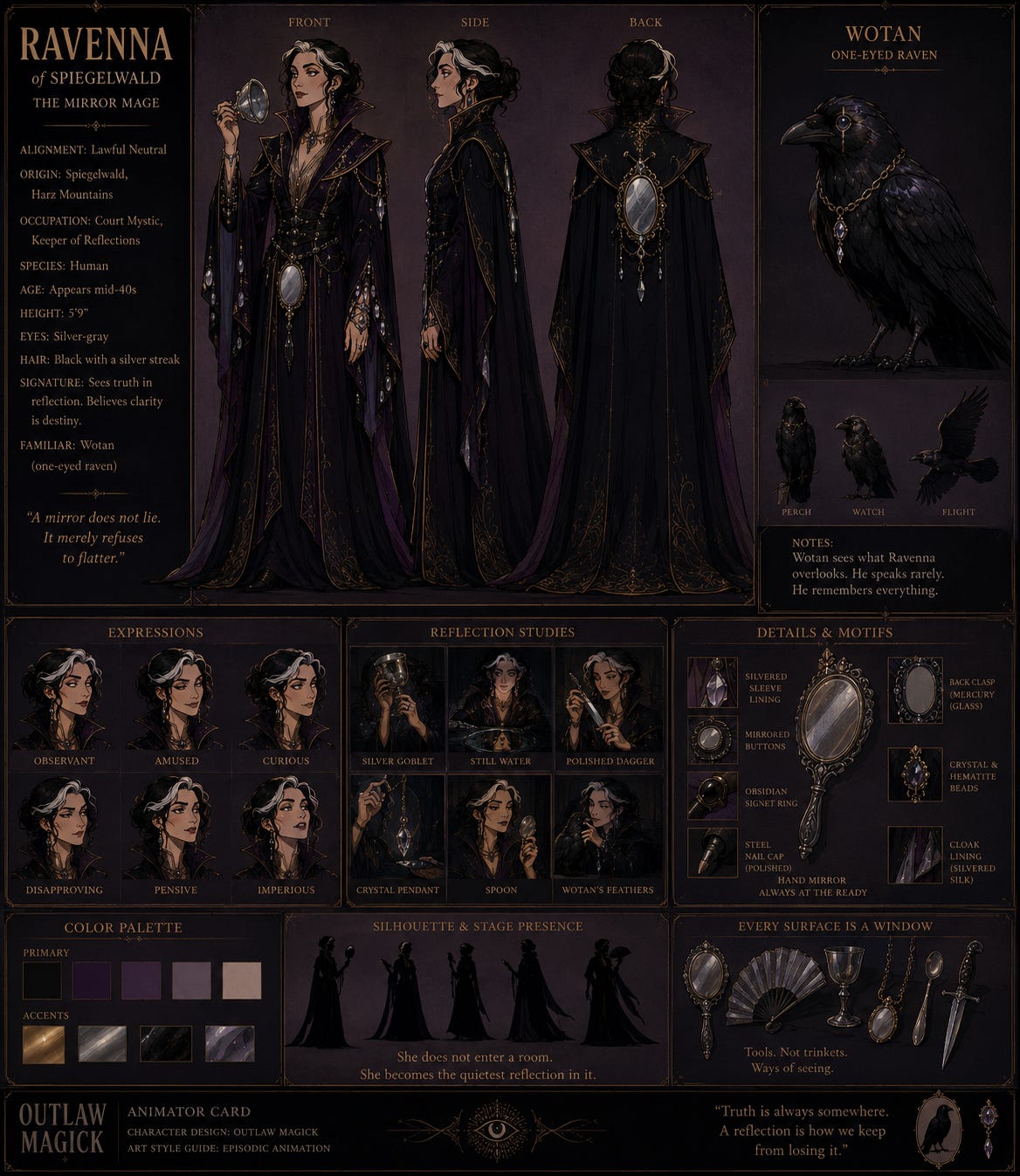
Author’s Note: This chapter draws on the Hogwarts Sorting Hat, the Scientology intake audit, the Tang Dynasty imperial examination, and the MRI machine — instruments that promised understanding through enclosure. The Crucible looks like an Iron Maiden. That was always the point. And this episode introduces Ravenna, our mirror witch: